
Plug-in “PunchOut Connect”: OCI and cXML for E-Procurement Integration in Smartstore
The digitization of B2B purchasing has been progressing consistently for years. Companies today expect supplier shops to seamlessly integrate into their existing ERP and eProcurement systems. This is exactly where a plug-in like “PunchOut Connect” comes in: It connects a Smartstore shop with professional procurement systems – based on established standards such as OCI and cXML.
But what does this mean concretely? And how do the underlying formats differ?
What is a PunchOut Catalog?
A PunchOut catalog allows buyers to switch directly from their internal procurement system to a supplier’s webshop. Instead of regularly importing product data into their own ERP system and maintaining it there, access is live to the shop’s current assortment.
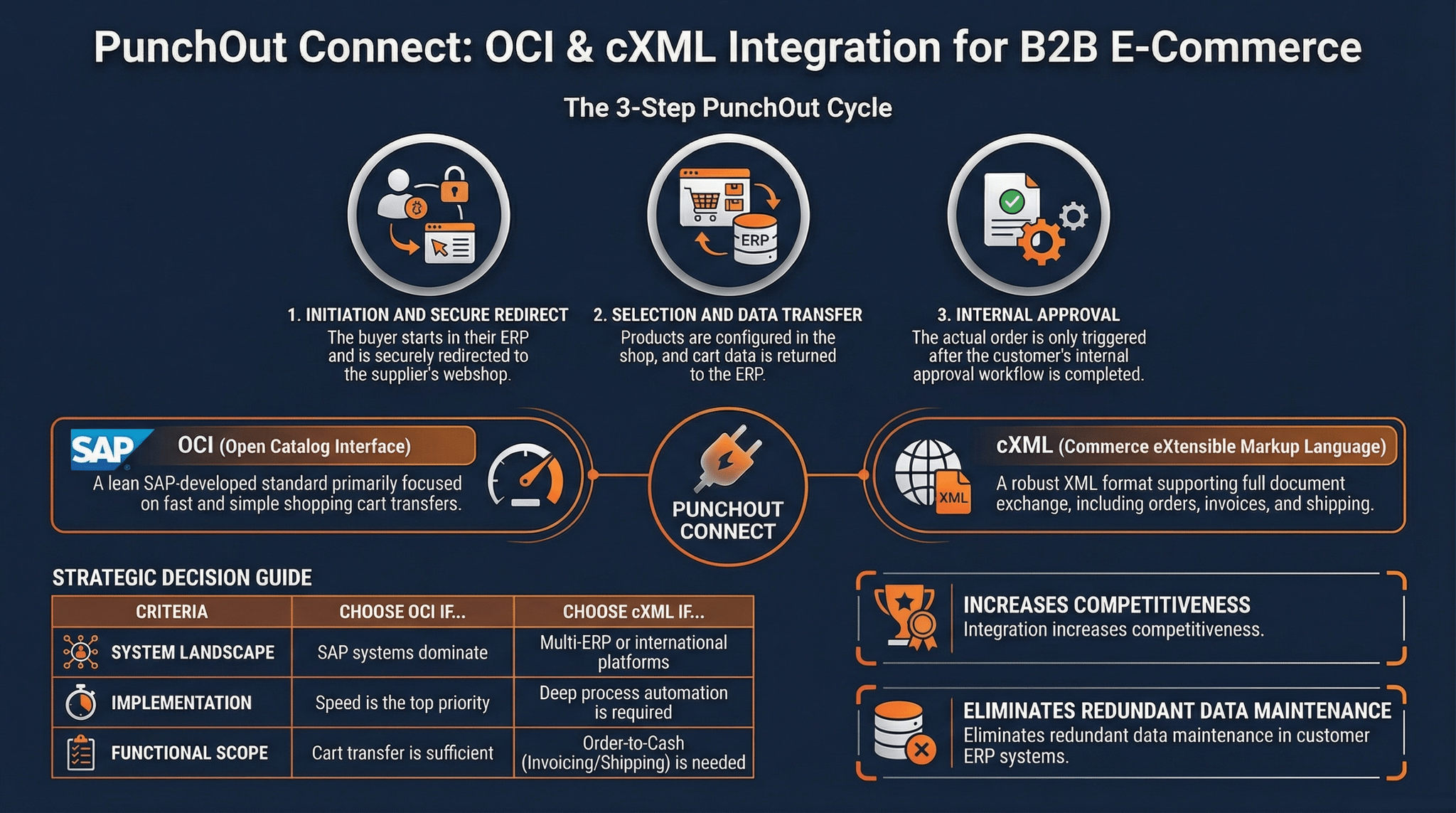
The process is clearly structured:
- The user starts in the internal purchasing system.
- They are forwarded to the supplier’s shop via an interface.
- Products are selected or configured there.
- The shopping cart is then transferred back to the purchasing system.
- The actual order is only placed after internal approval.
The decisive advantage: Prices, availabilities, and product information are always up to date, without redundant data needing to be maintained in the ERP. At the same time, internal processes such as budget checks, approval workflows, and compliance remain fully intact.
Especially with complex assortments – for example in the MRO sector, IT hardware or technical components – PunchOut combines operational flexibility with central process control.
OCI – the Pragmatic SAP Standard
OCI (Open Catalog Interface) is an interface developed by SAP for connecting external webshops to SAP procurement systems.
Technically, OCI is based on a comparatively simple HTTP mechanism: When switching to the shop, session information is transferred. After product selection, the shop sends the shopping cart data as structured name-value pairs via HTTP-POST back to the ERP system, which generates a purchase requisition from it.
Key features of OCI:
- Focus on shopping cart transfer (no full process integration)
- Low technical complexity
- Ideal for SAP-centric system landscapes
- Clear field definition and clean mapping are crucial
OCI is particularly suitable if a company primarily uses SAP and does not require further document processes (e.g., automated invoice transfer). The implementation effort is manageable – the real challenge lies in correctly mapping material groups, tax indicators, or account assignment information.
cXML – the Scalable Integration Format
cXML (Commerce eXtensible Markup Language) is an XML-based exchange format originally developed by Ariba (now part of SAP).
Unlike OCI, cXML is not limited to shopping cart return. It supports full electronic document exchange, including:
- PunchOutSetupRequest
- OrderRequest
- OrderResponse
- InvoiceDetailRequest
- ShippingNoticeRequest
The communication takes place via structured XML documents via HTTPS, allowing complex business processes, international tax logics, different currencies, and role-based security concepts to be mapped.
cXML is particularly relevant for:
- Multi-ERP environments
- International large customers
- Connections to networks such as the SAP Ariba Network
- End-to-end process automation from shopping cart to invoice
The price for this flexibility is a higher technical effort: XML parsing, schema validation, certificate management, and often middleware solutions are required.
Integration into a Smartstore Shop
For operators of a Smartstore shop, supporting OCI and cXML means a strategic expansion of B2B capabilities.
OCI Integration in Smartstore
For OCI, the shop must:
- Provide a defined OCI endpoint
- Process session and return parameters
- Correctly transmit mandatory fields such as description, price, quantity, product group
- Consistently map ERP-relevant data
The protocol itself is technically lightweight. However, data quality and field logic are critical – errors lead directly to interruptions in the customer’s procurement process.
cXML Integration in Smartstore
cXML connection requires:
- Processing of structured XML documents
- Support for PunchOutSetupRequest/Response
- Schema validation
- Secure authentication mechanisms (certificates or tokens)
- Optional connection to procurement networks
Here it’s not just about PunchOut, but about the possibility of a complete order-to-cash integration.
Strategic Decision: OCI or cXML?
The choice between OCI and cXML is not just a technical question but depends significantly on the target market and customer structure.
OCI is useful if:
- SAP systems dominate,
- quick implementation is desired,
- PunchOut at the shopping cart level is sufficient.
cXML is recommended if:
- multiple ERP systems are to be connected,
- international platforms are integrated,
- deep process automation is required.
For ambitious B2B shops, a modular architecture is recommended, where both standards are supported. This keeps the shop maintainable and flexible while encapsulating customer-specific integrations cleanly.
Conclusion
A plug-in like “PunchOut Connect” turns a Smartstore shop into a full-fledged B2B integration platform. Supporting OCI and cXML not only determines the technical integration level but also the strategic competitiveness in the e-procurement field.
Anyone who wants to serve B2B customers professionally must understand their system landscapes – and be technically connectable at exactly these points.
For further information, please click on the graphic.
Do you have any questions on this topic? Or would you like to send us your feedback? You can reach us via the contact form, by email at info@smartstore.com or by phone from Monday to Friday between 10 am and 4 pm at +4923153350.

Erfahrener Manager mit über 30 Jahren Expertise im E-Commerce. Spezialisiert auf die erfolgreiche Umsetzung komplexer Projekte, effiziente Prozessoptimierung und die Entwicklung automatisierter Lösungen.